
Dr. Harshit Pant
Scientist ·, G.B. Pant National Institute of Himalayan Environment (NIHE), Uttarakhand, India
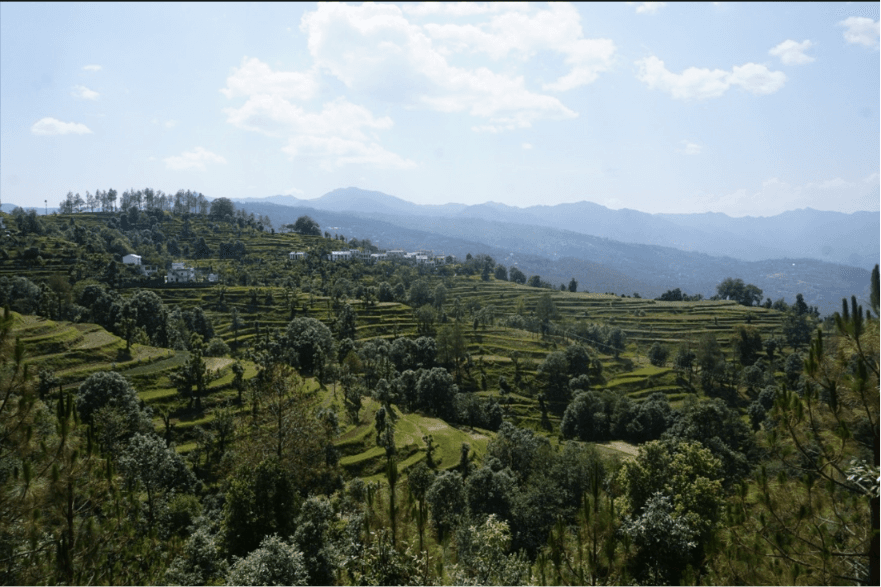
To a development economist, it was a masterclass to see how the Sustainable Development Goals are actually lived, not merely reported, but in the case of Uttarakhand, it is a ground truth which is being incorporated into daily lives. The institution behind this is the Van Panchayats (VPs), which are a democratically elected community forest council unique to Uttarakhand. First constituted in 1931 as a colonial concession to hill communities stripped of their forest rights, these councils, now numbering 11217, manage over about 5,350 sq km, which is about 13.4% of the state's total forest area and sustain the livelihoods of more than a million rural families. Yet they remain nearly invisible in mainstream SDG discourse. That invisibility is a serious analytical error. When Uttarakhand shared the top rank with Kerala in NITI Aayog’s SDG India Index 2023-24, scoring 79 out of 100 and rising from 9th place in 2019, most credit flowed to dashboards and planning frameworks. The deeper, messier, more consequential story is written in oak forests and pine ridges where Van Panchayats both drive SDG synergies and embody their most acute tradeoffs.
>"Unless the community becomes active, the forests will continue to burn." - Van Panchayat Sarpanch, Rudraprayag District, 2024
Uttarakhand’s CPPGG has built a genuinely impressive monitoring system: a State Indicator Framework of 369 indicators (231 national, 138 state-specific), a District Indicator Framework of 125 indicators, and a monthly dashboard tracking 36 key metrics across all 13 districts. Uttarakhand's SDG Dashboard, launched in December 2020, was the first in India to synchronize with the national platform. SDG targets have been integrated into the Gram Panchayat Development Plans of all three tiers of Panchayati Raj, supported by Training of Trainers workshops at block and district levels. VPs, however, operate in a distinct institutional register. They are not Gram Panchayats. Governed by the Panchayati Van Niyamawali (PVN), they exist at the hyphen between revenue governance and forest governance with a hybrid of state ownership and community responsibility that has defied simple categorization for over nine decades. Their SDG contribution is real but unmeasured
A well-managed VP forest intersects at least eight SDGs simultaneously. Forest produce, such as fodder, fuelwood, and medicinal herbs, provides a direct subsistence buffer for households near the poverty line, advancing SDGs 1 and 8. VP forests, contiguous with reserve forests and protected areas, maintain the Himalayan hydrological cycle that feeds springs and the river system; a forest council preventing illegal felling is simultaneously protecting drinking water for millions downstream (SDGs 3 and 6).
The climate and biodiversity contribution is where the undercounting is most glaring. A 2024 study in Frontiers in Forests and Global Change documented significant carbon stock losses from Uttarakhand's seasonal forest fires losses demonstrably lower where VPs maintain active fire-line management. Community vigilance is not a soft complement to SDGs 13 and 15; it is a hard input. Finally, the democratic, elected structure of VPs and their documented record of expanding women's leadership in forest governance in districts like Almora and Bageshwar make them a living embodiment of SDGs 5 and 16. The aggregate economic value of these services is not speculative. A 2018 government-commissioned study by the Indian Institute of Forest Management valued the ecosystem services generated by Uttarakhand's forested landscape at over ₹95,000 crore annually, encompassing carbon sequestration, watershed regulation, soil conservation, non-timber forest produce, pollination, and biodiversity habitat provisioning. All of this is sustained, at the community scale, by VPs governance. To put it plainly: the state's forests are a ₹95,000 crore asset, and VPs are its unpaid custodians. That custodianship maps directly onto SDG 13 (climate mitigation), SDG 15 (terrestrial biodiversity), SDG 6 (freshwater security), and SDG 14 (aquatic ecosystems fed by Himalayan streams), which is a multi-goal return on what amounts to zero public expenditure. If the state were to internalize even a fraction of this value through payments for ecosystem services or carbon credits routed to Van Panchayats, it would simultaneously advance SDG 1, fund institutional strengthening, and create a powerful incentive against forest degradation. None of these is captured in the CPPGG dashboard. The data exists across the Forest Department, Panchayati Raj records, and UNDP field documentation. The will to consolidate it into a Van Panchayat composite index does not envisage it on the ground.
>A Van Panchayat is not just a forest management body. It is an SDG integration platform without a budget line.
SDG localization literature celebrates synergies and papers over tradeoffs. In the VPs' context, the tradeoffs are structural and increasingly dangerous to ignore. SDG 8 vs. SDG 15: Rights to eco-tourism, herbal production, and minor forest produce are legitimate livelihood gains (SDG 8). But the 2024 PVN (Panchayati Van Niyamawali) amendments granted these rights without commensurate institutional strengthening. Expanded extraction without robust governance is a direct route to forest degradation (SDG 15). SDG 13 vs. SDG 15: Chir-pine covers roughly 28% of Uttarakhand's forests. Highly fire-prone and ecologically impoverished compared to the broadleaf oak it displaced, converting it back requires exactly the kind of long-term, community-led silvicultural management Van Panchayats could provide, but from which they are being progressively excluded. The 2024 wildfire season recorded 11,256 fire incidents across 11 of 13 districts; that is not a natural disaster, it is a governance failure. SDG 16 vs. SDG 17: The retreat from the comprehensive PVN 2023 draft, 58 progressive amendments ready for cabinet approval to a token 15-rule amendment in March 2024, strengthens bureaucratic control at the cost of the multi-stakeholder partnerships SDG 17 demands. As one VP sarpanch noted, community-department coordination on fire management was severed after 2016. That severance is a concrete, measurable SDG 17 regression. SDG 1 vs. SDG 15: Out-migration from Uttarakhand's hills, particularly in Almora and Pauri districts, improves household incomes through remittances (SDG 1) but hollows out the social capital on which VPs' governance depends. Empty villages cannot manage forests. The unpredictably recurring fire season is partly a story of under-staffed councils guarding forests from which the working-age population has departed.
The CAG’s 2024 audit found that Uttarakhand's SDG Dashboard for SDG-3 tracked performance against only 9 of 45 state-developed health indicators, which is a microcosm of a larger problem. The CPPGG framework monitors output metrics such as immunization rates, institutional deliveries, etc., rather than institutional health indicators: panchayat meeting frequency, fund utilization, and management plan quality. It measures what is administratively legible, not necessarily what is ecologically determinative.
VP governance quality indicators, such as community participation density, women's leadership, financial adequacy, and forest cover trends, are arguably the most powerful leading indicators of outcomes across SDGs 1, 6, 13, 15, and 16 in rural Uttarakhand. It is also entirely absent from the state's monitoring architecture. Correcting this is not technically difficult. It is politically inconvenient because it would make visible the cost of institutional regression.
It can be ascertained that Uttarakhand's SDG achievement is real, though the CPPGG infrastructure of dashboards, indicator frameworks, and district action plans is among the most sophisticated in India and genuinely replicable. But the state now faces a defining choice: double down on institutional frameworks that make SDG progress visible on paper or invest in community institutions that make it durable on the ground.
The comprehensive PVN 2023 draft 58 amendments to modernize governance, decentralize decision-making, and link VPs to the green economy represented a chance to demonstrate national leadership in aligning community forestry with the 2030 Agenda. That chance was not taken. Instead, token amendments were notified, fire management coordination has deteriorated, and the gap between Uttarakhand's headline SDG score and its on-ground institutional reality continues to widen. The VPs' user group of villagers tending their forest was not thinking about SDG 15. They were thinking about their trees, their springs, their families. That is precisely the point: the most durable SDG achievements do not require communities to speak the language of global frameworks. They require global frameworks to recognize what communities already do. VPs have been practicing integrated, multi-goal sustainability for nearly a century. The question for CPPGG and for the Government of Uttarakhand is whether the state's celebrated SDG architecture will finally make room for them not as beneficiaries, but as architects.
1. NITI Aayog SDG India Index 2023-24 — Uttarakhand Score: 79/100, Rank #1 (joint with Kerala)
2. CPPGG Uttarakhand SDG Tool — State Indicator Framework (SIF): 369 indicators | District Indicator Framework (DIF): 125 indicators | Monthly SDG monitoring tool: 36 indicators
3. Van Panchayat statistics: 12,089 Van Panchayats managing 7,350.85 sq km (13.41% of total forest area) — IIFM data
4. Ecosystem services valuation: INR 95,000 Cr/year — IIFM 2018 (Government of Uttarakhand sponsored study)
5. Forest fire data: 11,256 incidents across 11 of 13 districts, Nov 2023–Jun 2024 — Uttarakhand Forest Department / FSI
6. Chir-pine coverage: ~28% of forest area — Singh et al. 2016; Fulé et al. 2021, cited in Bargali et al. 2024 (Frontiers in Forests and Global Change)
7. PVN 2024 amendments: Government of Uttarakhand, March 2024 (15-rule amendment of PVN 2005); Down to Earth, March 2026
8. CAG Audit findings on SDG-3 indicator coverage — Chapter 9, CAG Report 2024
9. SDG Dashboard launch: December 2020 — Uttarakhand was the first state to sync its dashboard with the national India SDG Dashboard
10. CPPGG SDG monthly monitoring tool: monitors 36 indicators at monthly interval — UNDP India Project Documentation
Data source: CPPGG Uttarakhand SDG Tool · NITI Aayog SDG India Index 2023-24 · UNDP India · Forest Department, Government of Uttarakhand