DV
Dr. Vijay Kumar
Assistant Professor, Department of Environmental Studies, Satyawati College, University of Delhi
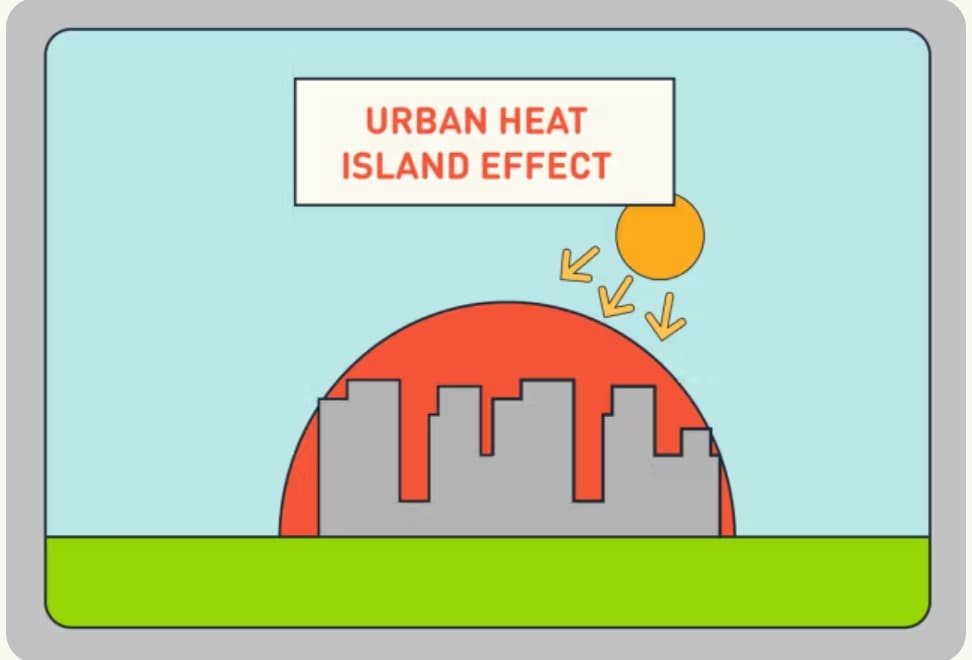
Urban Heat Island (UHI) is a phenomenon where metropolitan cities experience significantly elevated temperatures compared to rural areas. This temperature differential arises primarily from the transformation of the natural landscape into the built environment, characterized by impervious surfaces, reduced vegetation, and increased anthropogenic heat sources. The classic studies describe the UHI as resulting from altered surface energy balance: the built materials used in urban areas, like concrete and black colored asphalt, absorb greater solar radiation during the day and release it very slowly after sunset, while the reduced evapotranspiration from vegetation loss limits cooling.
Globally, UHI typically intensifies in the ranges from 1-3°C but can reach up to 5–12°C under specific conditions such as clear and calm nights. In tropical and subtropical regions like India, the effect is often more pronounced due to high solar insolation, dense urbanization and monsoon-influenced humidity patterns.
The rapid increase urbanization in developing countries has made UHI a pressing concern for urban planners and environmental scientists. As cities expand horizontally and vertically to accommodate growing populations, the replacement of permeable surfaces with buildings, roads, and infrastructure fundamentally alters local microclimates. In India, where urban population is projected to rise sharply in the coming decades, this transformation is particularly visible in megacities. Studies reveal that land-use changes, such as declines in vegetation indices and increases in built-up density, serve as strong predictors of rising urban temperatures.
Understanding UHI is essential not only for assessing current environmental conditions but also for anticipating future risks under climate change scenarios. The phenomenon interacts with broader global warming trends, often amplifying heat stress during extreme weather events. For researchers and policymakers in institutions addressing UHI, it offers an opportunity to develop locally relevant solutions that enhance urban resilience, improve livability, and support sustainable development goals.
The replacement of permeable, vegetated surfaces with low-albedo materials, for example, asphalt, concrete, and rooftops, increases heat absorption. The built-up areas have higher thermal inertia, storing heat and re-radiating it nocturnally. The reduced sky view factors in dense urban canyons trap longwave radiation and increase the temperature of the surrounding (Figure 1).
Figure 1: Conceptual framework of the Urban Heat Island (UHI) system: Anthropogenic drivers, microclimatic dynamics, multi-sectoral impacts, and science-backed mitigation frameworks for climate-resilient cities.
Cities are crowded with vehicles, small- and medium-scale as well as large-scale industries, and various infrastructure, including residential, commercial, and industrial. The infrastructure is laden with air conditioners. All of these add direct heat and contribute significantly to warming.
The urban areas with tall buildings and residential complexes create canyons that reduce wind ventilation and increase trapping of heat. The high thermal conductivity materials exacerbate the effect of UHI as compared to rural areas
Loss of green cover diminishes latent heat flux (the process of cooling through evapotranspiration). The surface UHI is measured via satellite Land Surface Temperature (LST), which differs from the canopy layer air temperature UHI. The surface UHI is more pronounced during the daytime and the latter at night. In tropical regions, high humidity can modulate intensities but amplify human discomfort. In India, studies conducted via Landsat, MODIS, and ASTER satellites reveal that rapid urbanization is the primary cause of UHI. Cities like Delhi show stronger gradients (up to 4–10°C), which is driven by impervious surface expansion and vegetation decline.
UHI brings notable changes to urban ecosystems and ecological processes. A key concern is the warming of stormwater runoff from paved surfaces, which raises temperatures in rivers, lakes, and streams. This sudden increase in water temperature harms aquatic life by disrupting biological functions such as reproduction and metabolic rates in fish and invertebrates. Urban biodiversity also declines as higher temperatures and shrinking green areas put stress on native plants and animals. Many species struggle with increased water loss through evaporation, while invasive or heat-resistant organisms gain advantages. This leads to reduced ecosystem services, including natural cooling, carbon storage, and soil health. In places like Delhi, the loss of wetlands and farmland to concrete development fragments habitats and weakens the city’s natural ability to regulate its environment (Figure 1).
At the local scale, UHI modifies weather and atmospheric conditions. Cities retain more heat, particularly after sunset, because rural areas cool faster. This creates differences in air movement and can influence cloud development or rainfall patterns in and around urban zones. The effect becomes more dangerous when combined with heatwaves, pushing temperatures higher and extending periods of uncomfortable warmth. Warmer urban air also speeds up chemical reactions that form ground-level ozone and other pollutants, worsening air quality. In Indian cities, this adds to seasonal pollution problems, such as summer ozone spikes and winter smog. Furthermore, greater need for cooling in buildings leads to higher electricity use, which often relies on fossil fuels and contributes to greenhouse gas emissions. Long-term satellite observations across India reveal growing surface temperature differences between cities and surrounding areas, highlighting the need for better integration of UHI into regional climate projections.
UHI creates significant economic costs across multiple sectors. Higher temperatures increase electricity demand for air conditioning and cooling systems, straining power supplies and raising expenses for families, industries, and city governments. In energy-constrained settings like many Indian states, this can lead to greater reliance on polluting sources and higher operational costs. Work productivity suffers as heat affects both outdoor labourers and those in poorly cooled indoor spaces, leading to reduced output in construction, manufacturing, and services. Infrastructure such as roads, bridges, and buildings experiences faster wear from repeated heating and cooling cycles, increasing repair and replacement expenses. These burdens fall unevenly. Lower-income areas and informal settlements often face stronger heat exposure due to limited greenery and dense construction, deepening social inequalities. In economic hubs like Delhi’s commercial districts, intense local warming affects business operations and real estate values. Overall, UHI-related issues influence urban planning priorities, migration trends, and progress toward sustainable development targets.
UHI directly threatens human well-being by elevating both daytime and nighttime temperatures, limiting the body’s ability to recover from heat exposure. This increase in temperature puts people at higher risk for dangerous heat-related issues like heat stroke, severe cramps, and exhaustion. The danger is especially high for vulnerable groups, including seniors, toddlers, pregnant individuals, and anyone managing long-term health conditions. When heatwaves overlap with strong UHI, excess deaths and hospital visits climb noticeably. Poor air quality resulting from higher temperatures further aggravates breathing problems like asthma and heart conditions. Additional concerns include increased dehydration, shifts in disease-carrying insects, and mental strain from ongoing discomfort. In Indian megacities, where many residents lack reliable cooling or healthcare access, these effects hit vulnerable communities hardest. Effective responses require better monitoring, timely alerts, and targeted support programs that address both UHI and broader climate risks.
Effective mitigation requires multi-pronged and context-specific approaches, which have been shown in Figure 1 and are as follows:
Green Infrastructure
Urban forests, green roofs/walls, parks, and street trees enhance evapotranspiration and shade. Studies show cooling of 2–4°C or more locally. In Delhi, expanding and connecting green spaces could yield significant benefits.
Cool Surfaces
High-albedo coatings on roofs and pavements reflect solar radiation, reducing surface temperatures. Reflective pavements and phase-change materials offer sustainable options.
Urban Planning and Design
Increasing sky view factors, promoting ventilation corridors, mixed-use developments with shading, and preserving water bodies. Local Climate Zone (LCZ) classification aids targeted planning in Delhi's sub-cities.
Policy and Community Actions
Integrating UHI into building codes, incentives for green buildings, heat action plans, and public awareness. Singapore and other models demonstrate scalable successes adaptable to India.
Technological Innovations
Use of ENVI-met simulations, machine learning for prediction, and cool materials research.
The Urban Heat Island effect is a critical urban challenge that amplifies climate vulnerabilities, particularly in rapidly growing cities like those in India. Through altered energy balances, LULC changes, and human activities, UHI drives higher temperatures with cascading environmental, health, and economic consequences. Delhi exemplifies these dynamics, underscoring the urgency for action. By drawing on global and local literature, evidence-based mitigation centered on greening, cool materials, and smart planning offers pathways to cooler, more resilient cities. As researchers and educators, we must advocate for integrated solutions that balance development with sustainability. Collaborative efforts between academia, government, and communities will be key to mitigating UHI and fostering livable urban futures.
1. AL-agele, H. R. M., Jaafar, M. F. Z., & Shahidan, M. F. (2024). Urban heat island effects and sustainable mitigation strategies in urban areas: case study Jakarta City. AUIQ Technical Engineering Science, 1(1), 7.
2. Deilami, K., Kamruzzaman, M., & Liu, Y. (2018). Urban heat island effect: A systematic review of spatio-temporal factors, data, methods, and mitigation measures. International journal of applied earth observation and geoinformation, 67, 30-42.
3. Islam, S., Karipot, A., Bhawar, R., Sinha, P., Kedia, S., & Khare, M. (2024). Urban heat island effect in India: a review of current status, impact and mitigation strategies. Discover Cities, 1(1), 34.
4. Mallick, J., Rahman, A., & Singh, C. K. (2013). Modeling urban heat islands in heterogeneous land surface and its correlation with impervious surface area by using night-time ASTER satellite data in highly urbanizing city, Delhi-India. Advances in Space Research, 52(4), 639-655.
5. Oke, T. R. (1982). The energetic basis of the urban heat island. Quarterly journal of the royal meteorological society, 108(455), 1-24.
6. Santamouris, M. (2020). Recent progress on urban overheating and heat island research. Integrated assessment of the energy, environmental, vulnerability and health impact. Synergies with the global climate change. Energy and Buildings, 207, 109482.
Disclaimer: The views expressed in this article are solely those of the author and do not necessarily represent the views, policies, or positions of the organisation.