
Dr Angana Kotokey
Research Fellow and Head of Operations, ARPA Foundation
Prolonged armed conflict and climate change are increasingly reshaping agricultural systems across the Global South, driving farmers away from traditional food crops towards opium poppy cultivation. Conflict-induced environmental degradation, food insecurity, water scarcity, and declining agricultural productivity have made poppy a resilient and economically attractive alternative in countries such as Afghanistan and Myanmar. By examining these conflict-affected states, this article highlights how the intersection of war and climate stress reinforces illicit economies and underscores the need for sustainable livelihoods, resilient agriculture, and post-conflict rural reconstruction.
Prolonged wars in the Global South have led to a disproportionate impact on agriculture and traditional crops—resulting in food insecurity across nations, most vulnerable to conflict. Alterations in native/indigenous crops have become visible after two of the most conflict-prone countries in India’s neighbourhood (Afghanistan and Myanmar in particular) became the largest producers of opium (drug) in the past decade. Poppy—a plant, an agricultural crop, a narcotic substance is also a socio-environmental phenomenon that exemplifies the complex relationship between conflict, climate change and environmental degradation. The impact of war on the environment remains multifaceted, and people—particularly farmers and pastoralists who depend on natural resources for their survival – are significant victims of conflict-induced climate change. Conflict disrupts the normal agricultural cycle by making it difficult for farmers to carry out both modern and traditional farming practices. As violence continues, farmers lose access to essential fertilizers and improved seeds, and rising insecurity prevents them from working long hours in the fields—thereby reducing crop productivity. As a result, in many countries across the Global South, conflict-induced disruptions to agriculture have driven some farmers to cultivate poppy—a high-value cash crop—that is relatively resilient to environmental stress and the harmful impacts of climate change. Therefore, the article below will discuss how environmental disasters in conflict-prone countries have altered traditional agricultural patterns—and have paved the way for some nations to become the largest producers of opium poppy in the region.
Climate change leading to conflict through food insecurity in the developing world are gaining attention among scholars and policymakers in recent years. However, the question of conflict-induced environmental hazards and their harmful impacts on agriculture remains debatable; although this intersection can undoubtedly give rise to the problem of food security—and exacerbate existing societal tensions. A research conducted on Ethiopia, which was published in Agricultural Economics in 2025, shows that prolonged conflict disrupts access to improved seeds, credit, and markets, forcing farmers to reduce investments in their land. When conflict extends beyond two years, even traditional soil management practices such as applying organic manure and compost decline due to insecurity, leading to soil degradation and reduced agricultural productivity. Conflicts damage agricultural landscapes by destroying and abandoning farmlands, displacing people, and weakening the institutions that support farming. As a result, the land becomes less productive, natural resources deteriorate, and the environmental benefits that agriculture provides to people and ecosystems are greatly reduced. For instance, in Gaza, more than half of the country’s agricultural land has been degraded by repeated conflict and heavy bombardments—with a rise in the destruction of orchards, field crops and vegetables in the Palestinian enclave. The United Nations Satellite Centre (UNOSAT) and the U.N. Food and Agriculture Organization (FAO) found that 57% of Gaza's permanent crop fields and arable lands essential for food security had shown a significant decline in density and health between May 2017 and 2024. Similarly, decades of conflict and crumbling infrastructure have left Iraq’s farmers struggling as damaged water supplies, combined with the looming threat of climate change, have pushed the country’s agriculture to the brink. Agriculture, which represented more than 18 percent of Iraq’s economic output in 1995, accounted for only 2 percent of the economic output due to war-led destruction by 2019.
Afghanistan, once largely self-sufficient in agricultural production, has witnessed a significant decline in food production and agricultural exports since the 1970s, undermining food security and rural livelihoods. Agriculture, which supports the livelihoods of more than 70% of Afghanistan's population, has borne the brunt of decades of armed conflict. Over forty years of war have severely damaged the country's agricultural systems by destroying farmland, irrigation infrastructure, and rural support networks. As a result, Afghanistan's agricultural sector has seen a prolonged decline, with its contribution to the country's GDP dropping from 71% in 1994 to 25% in 2020. Similarly, in Myanmar, prolonged conflict has disrupted agricultural patterns by reducing paddy production, crop yields, and the area of land under cultivation. As a result, farmers increasingly rely on lower-quality seeds due to growing insecurity and disrupted markets. Moreover, armed activities during the planting and growing seasons has caused the greatest losses, further weakening farmers' ability to cope with climate-related stresses such as droughts and changing patterns of rainfall. All these have led to reduced agricultural productivity, threatening food security and increasing the vulnerability of rural communities.
Additionally, environmental vulnerabilities such as water scarcity, rising temperatures, and soil degradation in conflict-driven nations have complicated traditional agricultural patterns—thereby reducing the viability of legal crops. Under such circumstances, the shift towards more resilient yet illicit agricultural alternatives, such as opium poppy cultivation, has become the most sustainable and cost-effective option.
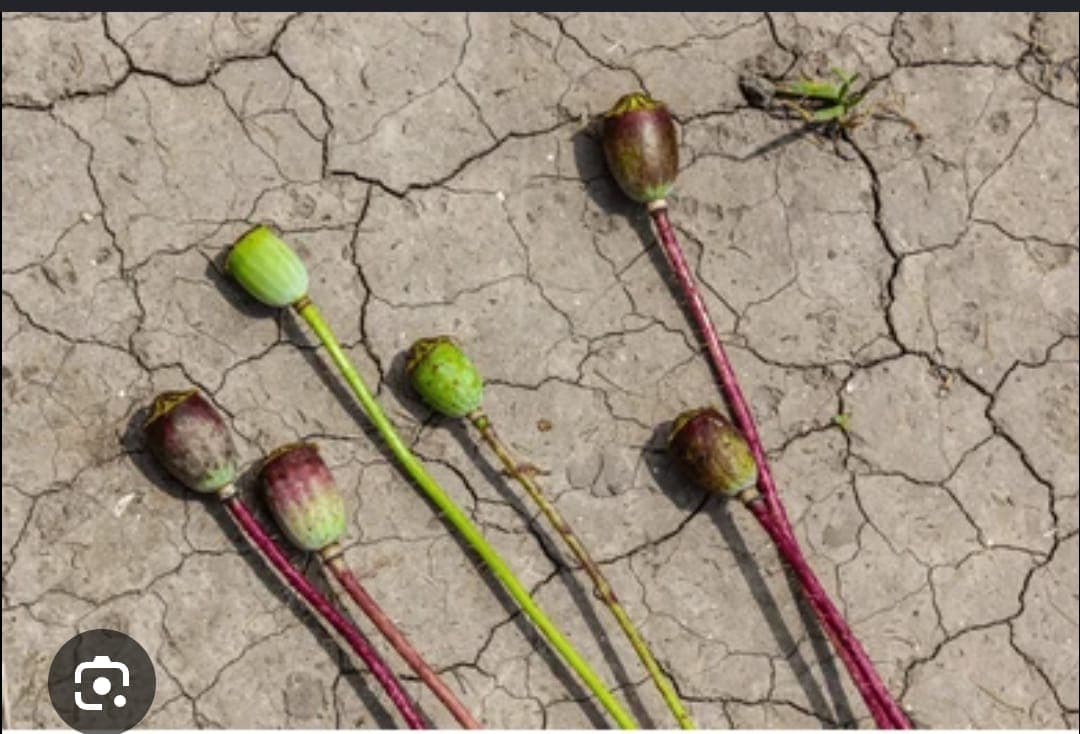
Opium poppy, which is a medicinal plant, has been known to humans since ancient civilizations, and continues to be cultivated around the globe for the production of pharmaceutical opiates and heroin. While the poppy straw harvested from cultivation is generally employed by pharmaceutical entities, the liquid or dried sap (known as opium latex or gum) is the starting material for the clandestine production of heroin. The growing of opium and its use have been part of the regular lifestyle for many people of the global south, where the local men have traditionally smoked opium in a tiny sphere, often the size of a ball bearing, and mixed with tobacco in a cigarette. Meanwhile, the womenfolk would eat it in various forms, and it became part of household consumption, grown in small patches close to the house and interspersed with other crops.
Despite the poppy being a multi-purpose plant with its presence in human life for ages, the usage and production of the opium poppy in many countries from the global south reveal that, with rising environmental shocks, it has by far been the most climate-resilient harvest in the region. In recent years, both Afghanistan and Myanmar—two conflict-fragile and violence-affected countries have become the largest producers of this illicit drug. In Afghanistan, decades of armed conflict and increasing climate stress have reshaped agricultural patterns, encouraging a shift towards opium poppy cultivation. The country is among the world's most climate-vulnerable nations, experiencing rising temperatures, changing rainfall patterns, prolonged droughts, and more frequent extreme weather events. Conflict has further intensified these environmental pressures by damaging irrigation infrastructure, contaminating soil and water through landmines and explosive remnants of war, and disrupting traditional water management systems such as the Qanat (Karez) network. According to several reports, Afghanistan has experienced a temperature rise considerably higher than the global average, amounting to 1.8 ℃ between 1951 and 2010. The temperature rise is anticipated to last from 2006 until 2050 and rise by 1.7–2.3 ℃, and afterwards by 2.7–6.4 ℃ until 2099, throughout the country. Provinces such as Helmand and Kandahar, which have experienced significant temperature increases during years of conflict, illustrate how environmental degradation and insecurity have made conventional farming increasingly difficult. As a consequence, poppy became the predominant cultivated crop in Helmand and Kandahar provinces of Afghanistan, which subsequently emerged as the country's largest opium-producing regions. Moreover, in the past forty years of conflict, the presence of explosive remnants of war (ERW) has exposed almost 4 million people to the constant risk of being harmed, with an estimated 1.2 million square meters of land contaminated by mines and improvised explosive devices—disrupting the overall food chain.
As agricultural conditions deteriorate, many farmers have turned to opium poppy as an alternative livelihood, as it requires less water, is more tolerant of dry conditions, and generates nearly three times more income per hectare. For farming households facing declining water availability, damaged irrigation systems, and limited economic opportunities, poppy cultivation has become a practical coping strategy. While often described as a "climate-resilient" crop because of its ability to survive under harsh conditions, its expansion ultimately reflects the combined impacts of conflict, climate change, and weakened agricultural systems rather than a sustainable adaptation strategy.
Meanwhile, in the case of Myanmar, prolonged conflict, economic instability, and environmental pressures have increasingly driven farmers towards opium poppy cultivation as a survival strategy. According to the Myanmar Opium Survey 2025, poppy cultivation increased by 17%, from 45,200 hectares in 2024 to 53,100 hectares in 2025, reversing the previous year's decline and continuing a steady upward trend since 2020. The most significant increases were recorded in East Shan State (32%) and Chin State (26%), both of which are heavily affected by armed conflict, weak state presence, and limited access to public services. For the first time, poppy cultivation was also documented in Sagaing Region, with 552 hectares under cultivation, reflecting its spread into areas that have become centres of conflict since the 2021 military takeover. South Shan, long the heart of Myanmar’s opium economy—accounts for 44 per cent of all poppy fields.
Although total opium production reached an estimated 1,010 metric tonnes in 2025, yields declined sharply in North Shan and Kachin due to intensified fighting, displacement of farming communities, repeated cultivation of the same fields without crop rotation, and limited access to fertilizers. Despite these declining yields, rising farmgate prices—averaging around US$365 per kilogram in 2025, more than double the 2019 price—have continued to make opium poppy an economically attractive crop. UNODC estimates that farmers earned between US$300 million and US$487 million from opium sales in 2025, providing a critical source of income as Myanmar's formal economy remains fragile. Therefore, its expansion in Myanmar is primarily driven by the combined effects of conflict, economic insecurity, and weakened agricultural systems. However, without viable alternative livelihoods and stronger support for rural communities, dependence on opium cultivation is likely to continue in the future in these conflict-driven and environmentally vulnerable countries.
From the above section, it could be understood that the intersection between conflict and climate change transforms traditional agricultural patterns, and both Afghanistan and Myanmar demonstrate how war and environmental pressures have contributed towards shifting from licit food crops to opium poppy production. Below, the discussion will further focus on probable sustainable initiatives which can be applied to resolve the problem.
• To strengthen alternative crop livelihoods
Despite poppy being a cash crop and a climate-resilient one, there is a need to create alternative food choices. Conflict-driven nations—facing climatic shocks can diversify cultivating poppy with more high-value legal crops, like saffron, fruits, nuts, and medicinal plants—thereby sustaining livelihoods and stimulating growth. Such initiatives have been undertaken in countries like Afghanistan, where poppy farmers earlier shared a good income from this illicit drug. United Nations Development Programme (UNDP) reported that the income from one hectare of opium in 2022 was around $6,800, while wheat (another climate-resilient crop) brought only $770 in Afghanistan. Meanwhile, crops such as saffron, nuts, and fruits are capable to generate higher income than wheat—and can bolster the options for an alternative agricultural crop. According to a UNDP 2024 report, “with approximately $90 million in funding from the US Bureau of International Narcotics and Law Enforcement Affairs, UNDP’s Community-Based Agriculture and Rural Development (CBARD) Project is supporting thousands of former poppy cultivators in the switch to high-value horticultural crops…Covering six provinces known for poppy cultivation, the initiative has transformed over 2,000 hectares of land, benefiting around 60,000 households.”
• To rebuild agricultural infrastructure
In the post-conflict reconstruction phase, rebuilding agricultural infrastructure is another important step to help farmers return to farming and improve food production in violence-affected areas. This includes repairing irrigation systems, dams, and water storage facilities, restoring rural roads and agricultural support services, and improving storage facilities to reduce post-harvest losses. For instance, UNDP has helped establish over 1,000 commercial and micro-greenhouses, more than 100 irrigation projects in Afghanistan—a water-scarce country and over 20 post-harvest handling facilities to preserve the quality of high-value crops. Meanwhile, in Myanmar, UNDP is helping rebuild agriculture by restoring irrigation infrastructure and promoting climate-resilient farming practices. In its southern Shan State, it has introduced solar-powered water pumps, fertigation systems that reduce fertilizer use and increase crop yields, renovated irrigation canals to improve water access, and established demonstration farms to promote improved rice varieties and sustainable farming techniques. These initiatives aim to increase agricultural productivity, strengthen farmers' livelihoods, and improve resilience to conflict and climate-related challenges.
• Strengthen mechanisms to eliminate narcotics-trade
Apart from conflict causing environmental disasters that adversely impact legal crop production, the rise in opium poppy also demonstrates its importance in the narcotics trade in the region and beyond. Weak governance, political corruption, and the failure of alternative livelihood programmes have made it difficult for farmers to transition to licit crops, allowing the narco-trade to thrive by exploiting poverty, insecurity, corruption, and the lack of sustainable economic opportunities in farming communities. For conflict-affected countries such as Afghanistan and Myanmar, reducing opium poppy cultivation requires addressing conflict, poverty, climate stress, and weak governance rather than relying solely on crop eradication. UNODC, FAO, UNDP, the World Bank, and regional governments should promote alternative livelihoods, rebuild agricultural infrastructure, strengthen governance, improve market access, and support climate-resilient farming, while enhancing intelligence sharing, satellite monitoring, cross-border cooperation, and targeting major drug trafficking networks instead of subsistence farmers. Ultimately, unless conflict, climate vulnerability, and rural economic insecurity are addressed together, opium poppy cultivation will remain not merely an illicit crop, but a symptom of deeper structural failures that continue to undermine sustainable development and human security across the Global South.
Disclaimer: The views expressed in this article are solely those of the author and do not necessarily represent the views, policies, or positions of the organisation.