PP
Prem Prakash Singh
Government Mahali Bhagat College, Kusmi, Balrampur, Chhattisgarh (India)
Creativity, invention, and innovation have always driven human progress. Today, science and technology are pushing us into uncharted territory. We're seeing quantum computing merge with artificial intelligence, and that's changing what's possible. But here's the thing: the problems we face now are too big for any single field to solve alone. Climate change, food insecurity, water pollution, energy crises, public health emergencies, extreme poverty. These aren't just scientific problems. They cut across economics, politics, and society. The only way to tackle them is by pulling ideas from multiple disciplines and combining them in new ways. We also need to look at how nature solves problems and learn from those solutions.
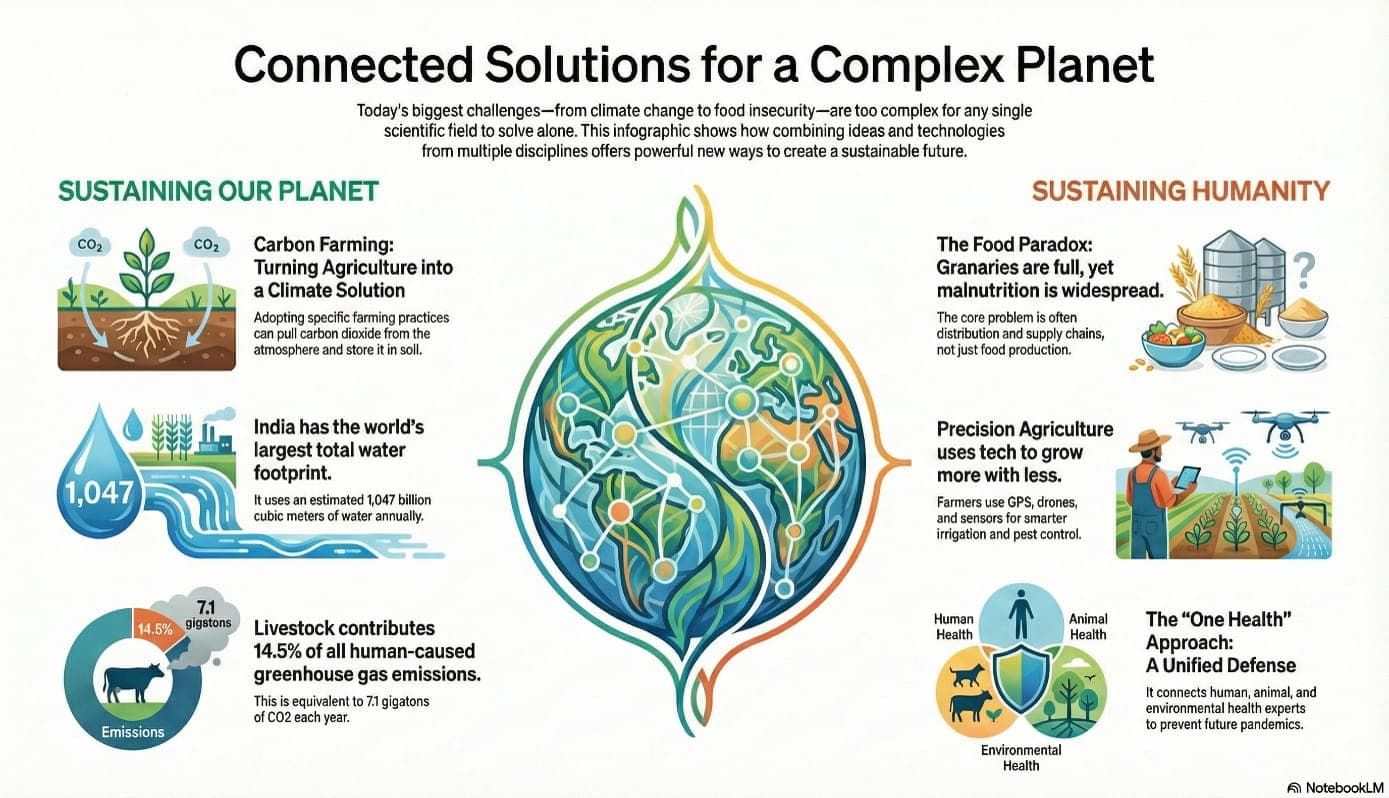
Our agricultural systems are under enormous pressure. We need to feed a global population of 7.5 billion while dealing with unpredictable weather, depleted soils, and dwindling water supplies. Precision agriculture is part of the answer. Farmers are now using GPS, drones, sensors, and data analytics to make smarter decisions about irrigation, fertilizers, and pest control. The goal is straightforward: grow more food while using fewer resources and causing less environmental damage. The Internet of Things is opening up even more possibilities. Connected sensors can monitor soil nitrogen levels, moisture content, pH, temperature, humidity, and dozens of other variables in real time. They can detect crop diseases early, predict yields, and even spot fires before they spread. This isn't science fiction. It's happening now. Genetic engineering has come a long way too. Tools like CRISPR-Cas9 let scientists make precise edits to plant genomes. They're developing crops that produce higher yields, resist pests and diseases, tolerate drought, and pack more nutritional value. Vertical farming, controlled environment agriculture, and smart irrigation systems are all contributing to what might become a more sustainable food system. But there's a paradox here. After the Green Revolution, global food production surged. Yet food insecurity persists. The problem isn't just production. It's distribution. Our supply chains don't effectively connect farmers to consumers. Meanwhile, conventional farming practices drain groundwater, burn through fossil fuels, and pump greenhouse gases into the atmosphere.
India offers a telling example. The country is now self-sufficient in food production. Granaries are overflowing. Yet malnutrition remains widespread. Programs like POSHAN Abhiyan, launched by the Indian government, aim to improve nutrition outcomes for mothers and children. But the disconnect between agriculture and nutrition runs deep, and farm women need to be central to any large-scale nutrition efforts.
Carbon farming represents a promising approach to climate change. The basic idea is to adopt agricultural practices that pull carbon dioxide out of the atmosphere and store it in plants and soil. This connects closely to regenerative agriculture, which focuses on building soil health and improving farm ecosystems over time.
Carbon credits add a financial incentive. These tradable permits let companies offset their emissions by supporting projects that reduce or remove greenhouse gases. One credit typically represents one ton of carbon dioxide. Farmers who adopt sustainable practices can generate these credits, creating a new revenue stream while helping the planet.
Sustainable Development Goal 6 focuses on water and sanitation for everyone. To understand the challenge, it helps to think about water footprints. This metric captures not just the water we drink and use directly, but also the water needed to produce everything we consume. The numbers are sobering. India has the world's largest total water footprint at 1,047 billion cubic meters per year. China follows at 967 billion, then the United States at 826 billion. Meanwhile, per capita water availability keeps declining as demand grows across sectors. India urgently needs a sustainable approach to ensure water security in the coming decades.
Livestock production contributes significantly to climate change. The sector emits an estimated 7.1 gigatons of CO2-equivalent each year, about 14.5 per cent of all human-caused greenhouse gas emissions. There's growing recognition that we need to protect our remaining forests and grasslands. They support biodiversity, store carbon, and provide essential ecosystem services. But they're under pressure from multiple directions. Changing diets means more demand for meat and processed foods. Cities keep expanding. Renewable energy projects, including biofuels, compete for land.
Some researchers talk about a food-energy-environment trilemma. Food production and energy production both need land, and both stress the environment. Sustainable intensification, getting more from each acre without degrading ecosystems, might offer a path forward. So would be cutting food waste. Eliminating waste could significantly reduce the need to boost food production by 60% projected for 2050.
Consider this: one in nine people worldwide is chronically undernourished, while a similar proportion is severely obese. This dietary imbalance is becoming a global health crisis that strains medical systems, hurts economies, and shortens lives.
The health challenges we face are multiplying. Infectious diseases keep jumping from animals to humans: COVID-19, Nipah virus, Kyasanur Forest Disease, H1N1 influenza, Chikungunya, avian flu, and others. At the same time, non-communicable diseases like heart disease and diabetes are on the rise. Climate change is creating new health risks.
Antimicrobial resistance is making infections harder to treat. Mental health problems and neurodegenerative disorders are increasingly common. Preventing these diseases long-term requires what's called a One Health approach. This means bringing together experts from human medicine, veterinary medicine, and environmental science to work on problems collaboratively. It means using evidence to guide decisions. Modern technology is helping. Computer-aided drug design and computational models are speeding up drug discovery. Organ-on-a-chip technology creates miniature replicas of human organs for testing, bridging the gap between lab experiments and real-world results. Scientists are engineering therapeutic proteins with enhanced properties that often work better than natural versions. Vaccine technology is advancing too. SMART Vaccines is a digital tool that helps decision-makers evaluate different vaccines based on factors like disease burden, efficacy, and cost. In veterinary medicine, companies like HIPRA are developing vaccination systems with RFID technology for traceability and real-time monitoring. These innovations matter because monitoring animal health is essential for preventing the next pandemic.
Drug delivery systems have also improved dramatically. New approaches reduce the dosage animals need while making medications more effective and easier to administer. This benefits livestock, pets, and wildlife alike.
Nanotechnology is transforming healthcare. Working at the nanoscale, scientists are developing better ways to diagnose diseases, deliver drugs to specific targets, regenerate damaged tissues, and personalize treatments. Lab-on-a-chip devices pack entire laboratories into tiny spaces. Nanomaterial scaffolds help tissues heal. Nanodevices can continuously monitor vital signs. Researchers are even exploring nanobots, microscopic machines that could potentially perform surgery, deliver drugs, or repair tissues from inside the body. We're not there yet, but the research is ongoing.
Fossil fuels present two fundamental problems: they're finite, and burning them drives climate change. This has sparked a global search for alternatives. Solar, wind, hydropower, geothermal, bioenergy, tidal, wave, hydrogen, and nuclear power all offer potential pathways to a cleaner energy future. The transition won't be simple. Each alternative has trade-offs. But the direction is clear.
The innovations described here represent powerful tools. They can help us address climate change, transform societies, tackle national challenges, and advance sustainable development. India has a particularly important role to play in this global effort. Success depends on making scientific innovation central to both national and international initiatives. The UN Sustainable Development Goals lay out the vision: ending poverty and hunger, promoting health and well-being, ensuring clean air and water, providing affordable clean energy, encouraging responsible consumption, taking climate action, building peace and justice, strengthening institutions, and fostering partnerships for progress. These goals are ambitious. Meeting them will require sustained commitment and collaboration across disciplines. But the tools are within reach. The question is whether we'll use them.
Disclaimer: The views expressed in this article are solely those of the author and do not necessarily represent the views, policies, or positions of the organisation.